
Psyllium Husk Grades
Psyllium Husk Grades
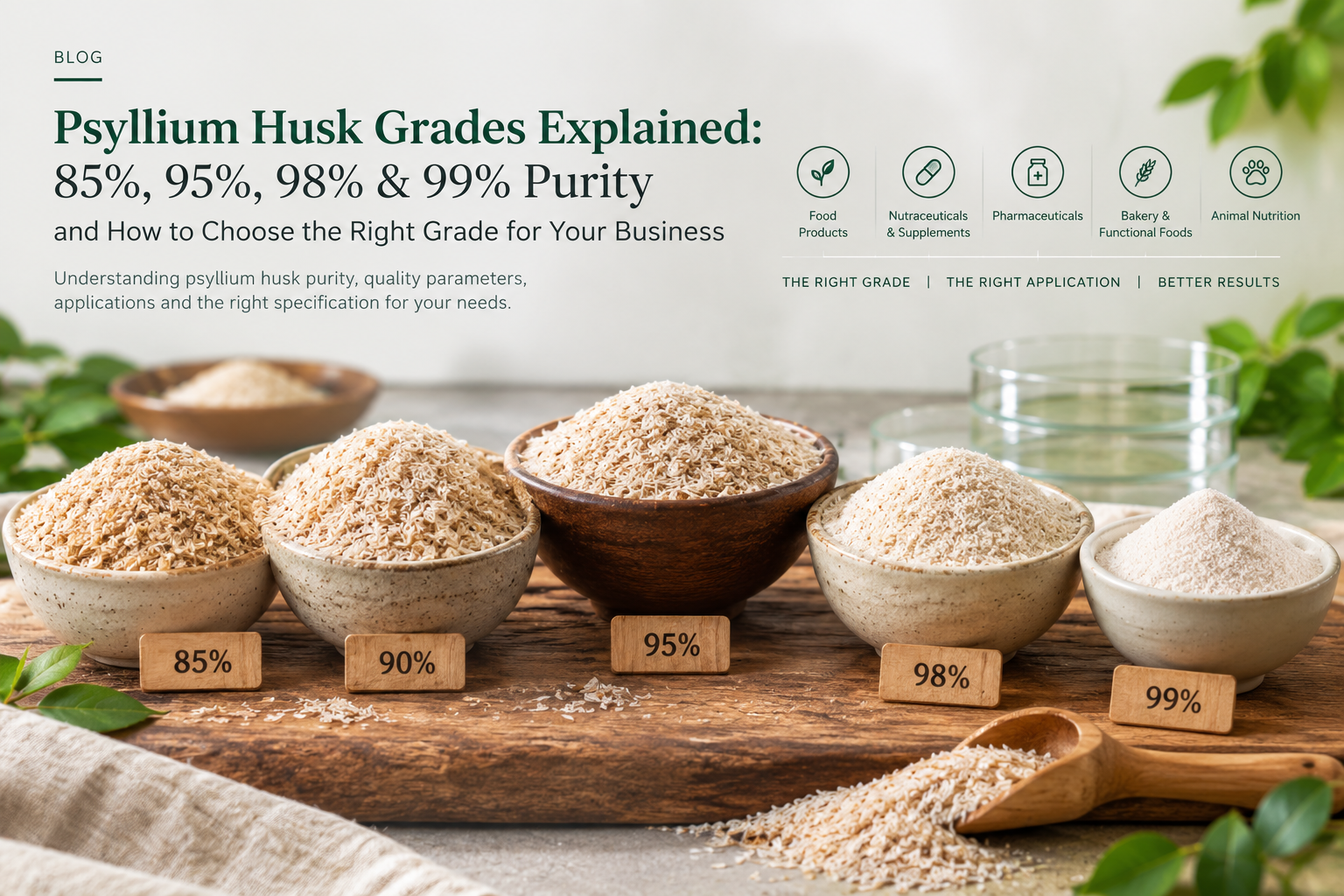
Psyllium Husk Grades Explained: 85%, 95%, 98% & 99% Purity and How to Choose the Right Grade
Understanding psyllium husk purity, quality parameters, applications and the right specification for your business.
Psyllium Husk Is Not a One-Grade Product
When sourcing psyllium husk, one of the first things buyers encounter is a series of numbers — 85%, 90%, 95%, 98%, 99% and sometimes even higher specifications.
But what do these numbers actually mean?
The purity grade can influence the quality, functional performance, application suitability and commercial value of psyllium husk. Choosing the right grade is therefore an important part of procurement, particularly for food, nutraceutical and pharmaceutical applications.
However, purity percentage should not be considered in isolation. A complete psyllium specification may also include swelling capacity, moisture, ash, microbiological parameters, foreign matter, particle size and other quality requirements.
At Indyagro Foods Pvt. Ltd., we believe buyers should select psyllium based on the actual requirements of their application, rather than simply choosing the highest number available.
01. What Does Psyllium Husk Purity Percentage Mean?
Psyllium husk is obtained from the outer coating of Plantago ovata seeds.
The percentage used to describe a commercial grade generally indicates the purity or proportion of desired husk material in the product, according to the supplier's specified testing method and specification.
As the grade increases, the product generally represents a cleaner and more refined material.
But there is an important point for buyers:
A 99% grade is not automatically the right choice for every application.
The appropriate grade depends on what you are manufacturing, the regulatory requirements of your destination market, the desired functional properties and your commercial requirements.
A supplier should therefore provide a Certificate of Analysis (COA) and detailed product specification for the actual lot rather than relying only on a number printed on a quotation.
02. Understanding the Main Psyllium Husk Grades
Different suppliers and markets may use somewhat different commercial grade classifications, so buyers should always confirm the specification behind the grade name.
Here is a practical overview:
|
Psyllium Grade |
General Positioning |
Typical Applications |
|---|---|---|
|
85% |
Standard / economical |
Food processing, selected feed applications |
|
90% |
Standard food grade |
Food products, fibre formulations |
|
95% |
Food / higher-grade applications |
Functional foods, bakery, nutraceutical formulations |
|
98% |
High-purity grade |
Nutraceuticals, dietary supplements, premium food applications |
|
99% |
Premium / pharmaceutical-oriented |
Pharmaceutical and high-specification applications |
These are commercial descriptions rather than universal regulatory definitions. The actual specification, testing method and applicable pharmacopeial or food standard should always be checked before purchase.
03. 85% Psyllium Husk — An Economical Option
Lower-purity psyllium grades can be suitable when the application does not require a highly refined ingredient.
They can be considered for selected:
- Food-processing applications
- Fibre formulations
- Animal nutrition applications
- Cost-sensitive formulations
- Industrial applications
The advantage is primarily commercial: buyers may achieve a lower raw-material cost where very high purity is not necessary.
However, the grade should always be evaluated against the finished product's technical and regulatory requirements.
04. 90% Psyllium Husk — Standard Commercial Grade
90% grades can provide a balance between functionality and cost for applications where pharmaceutical-level specifications are not required.
Depending on the buyer's specification, these grades may be considered for:
- Food manufacturing
- Fibre-enriched products
- Bakery applications
- Functional food formulations
- Selected industrial applications
As with any psyllium grade, the actual COA and agreed specification are more important than the grade name alone.
05. 95% Psyllium Husk — A Versatile Food-Grade Choice
95% psyllium is commonly positioned toward higher-quality food and functional applications.
It can be suitable for applications such as:
Gluten-Free Bakery
Psyllium can contribute to water binding and dough structure in gluten-free formulations.
Functional Foods
It can be incorporated into products designed around dietary fibre.
Food & Beverage Formulations
Depending on particle size and formulation requirements, psyllium can be used in various food products.
Nutraceutical Applications
Some formulations may use 95% material where the required product specification allows it.
For buyers, 95% can represent an attractive balance when the application does not require the additional specification associated with a higher grade.
06. 98% Psyllium Husk — High-Purity Psyllium for Premium Applications
98% psyllium is generally positioned as a high-purity commercial grade.
It can be considered for:
- Dietary supplements
- Nutraceutical products
- Premium food formulations
- Fibre powders
- Selected beverage formulations
- Applications requiring a cleaner, higher-purity raw material
For many buyers, the decision between 98% and 99% should not simply come down to which number is higher.
Instead, the question should be:
What does your formulation and regulatory requirement actually demand?
If 98% meets the agreed specification and application requirements, paying for a higher grade may not necessarily provide a commercial advantage.
07. 99% Psyllium Husk — High-Specification Material
99% is generally positioned at the premium end of commercial psyllium grades.
It may be considered for applications where buyers require particularly high purity and tighter quality specifications, including certain pharmaceutical and premium nutraceutical applications.
However, the label "99%" by itself does not establish pharmaceutical compliance.
For pharmaceutical applications, buyers should verify the applicable pharmacopeial requirements and request supporting documentation and test results.
Depending on the destination market and application, relevant standards may include USP, BP, EP or IP, where applicable.
08. Purity Isn't the Only Number That Matters
This is one of the most important things a psyllium buyer should understand.
A supplier might quote:
"98% Psyllium Husk"
But that doesn't tell you everything about the product.
A proper technical evaluation can include parameters such as:
Swelling Capacity
An important functional characteristic of psyllium and one of the parameters used to assess its performance.
Moisture
Helps assess product stability and storage suitability.
Ash
Provides information about inorganic/mineral content.
Acid-Insoluble Ash
Can be relevant when assessing mineral or siliceous contamination.
Microbiology
Depending on the application and market, parameters can include Total Plate Count, yeast and mould, E. coli and Salmonella.
Heavy Metals
Requirements may apply depending on the destination market and end application.
Foreign Matter
Important for assessing the cleanliness of the finished product.
Particle Size / Mesh
Particularly important for psyllium powder and formulations where texture, dispersion or processing behaviour matters.
09. Psyllium Husk Grade vs. Mesh Size — Don't Confuse the Two
Another common misunderstanding is treating purity grade and mesh size as the same thing.
They aren't.
Purity
Describes the quality/purity specification of the psyllium material.
Mesh
Describes particle size or fineness, particularly for powdered material.
For example, a buyer might specify:
98% purity + 80 mesh
rather than simply asking for "98% psyllium."
Different particle sizes can be useful for different applications. Coarser material may be preferred for certain bakery applications, while finer powders can be useful in supplements, beverage mixes and other formulations.
Therefore, when requesting a quotation, buyers should specify both grade and particle size where relevant.
10. How to Choose the Right Psyllium Grade for Your Business
Instead of asking:
"What is your highest grade?"
a better procurement approach is:
Step 1 — Define Your Application
Are you manufacturing:
- Dietary supplements?
- Nutraceuticals?
- Pharmaceutical products?
- Gluten-free bakery products?
- Functional foods?
- Fibre beverages?
- Animal nutrition products?
Step 2 — Identify Your Required Specification
Determine the required:
Purity + Swelling Capacity + Mesh + Moisture + Microbiology + Other Parameters
Step 3 — Check Destination-Market Requirements
Your destination country may have specific regulatory or food-safety requirements.
A specification suitable for one market may not automatically satisfy another.
Step 4 — Compare the COA
Don't compare suppliers solely on price.
Compare the actual technical specifications and test results.
Step 5 — Test a Sample
For regular commercial procurement, sample evaluation can help confirm that the material performs as expected in your formulation before moving to larger volumes.
11. How to Reduce Psyllium Procurement Costs Without Sacrificing Quality
Choosing a lower grade isn't always the best way to reduce costs.
There are other approaches.
Buy According to Application
Don't pay for specifications your product doesn't require.
Plan Volumes
Larger and better-planned orders can sometimes provide more favourable commercial terms.
Establish Regular Supply
A consistent procurement programme can make supply planning easier for both the buyer and supplier.
Standardise Your Specification
A clear specification reduces misunderstandings and makes supplier comparisons easier.
Evaluate Samples Before Bulk Procurement
Testing the actual product can prevent expensive problems later.
12. What Should You Ask a Psyllium Supplier?
Before placing an order, international buyers should consider requesting:
Product specification
Certificate of Analysis
Purity specification
Swelling capacity
Mesh / particle size
Moisture
Microbiological parameters
Heavy-metal parameters where applicable
Packaging details
Country of origin
Applicable certifications
Sample for evaluation
This gives procurement teams a much clearer basis for comparing suppliers.
13. Why Indian Psyllium Is Important to Global Buyers
India has developed a strong agricultural and processing ecosystem around psyllium.
Growing regions, farmer networks, procurement systems, processing infrastructure and established export channels have helped India become an important source of psyllium for international markets.
For buyers, this ecosystem provides access to different grades and formats while allowing suppliers to work around specific application requirements.
At Indyagro Foods Pvt. Ltd., our approach connects agricultural sourcing with processing and export operations, with a focus on delivering consistent products for international markets.
14. Choosing the Right Grade With Indyagro Foods
At Indyagro Foods Pvt. Ltd., we understand that one psyllium specification does not fit every business.
Our approach is to understand the intended application and required specifications before recommending a suitable product.
Whether the requirement is for:
Food | Nutraceutical | Dietary Supplement | Pharmaceutical | Bakery | Fibre Products | Animal Nutrition
we focus on matching the product specification with the intended application.
Our objective is not simply to supply the highest grade.
It is to supply the right grade for the right application.
Final Takeaway
When buying psyllium husk, purity percentage is only the starting point.
An informed procurement decision should consider:
Purity → Swelling Capacity → Particle Size → Moisture → Microbiology → Regulatory Requirements → Application → Cost
A 99% product isn't automatically better for every formulation, just as choosing a lower grade simply because it is cheaper can create problems later.
The best grade is the one that meets your technical and regulatory requirements while making commercial sense for your product.
Need help selecting the right psyllium specification?
Talk to Indyagro Foods Pvt. Ltd. about your application, required grade and volume requirements.
From Indian agriculture to global markets.